
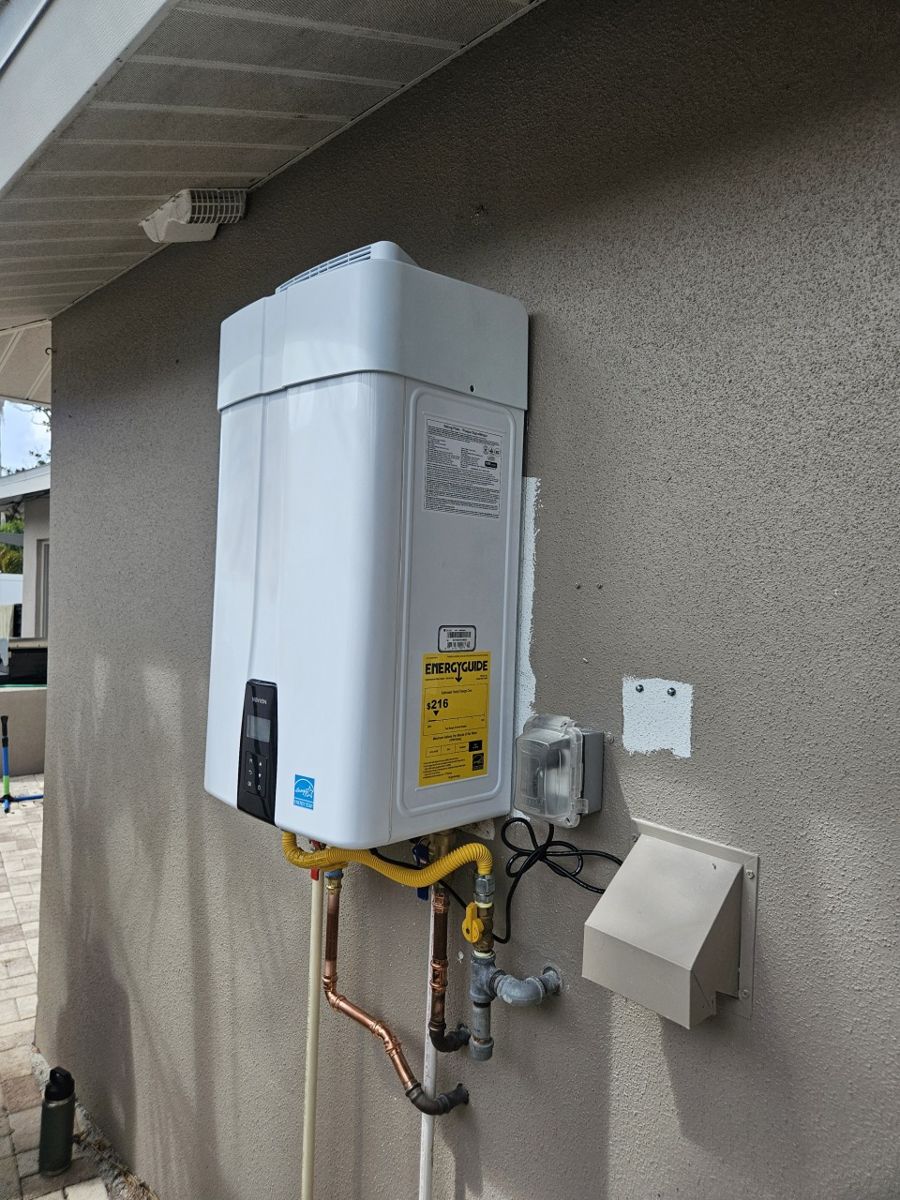
A tankless water heater can last 20 years or more, but only if it gets one simple piece of care: regular descaling. Here in Tampa Bay, our hard water leaves mineral scale inside the unit faster than in most of the country. Skip descaling for a few years and you can end up with lukewarm showers, error codes and a repair bill that could have been avoided. Our team explains why descaling matters, how often to do it and what the service involves.
Why tankless units need descaling
A tankless water heater heats water as it flows through a small heat exchanger. Those passages are narrow, and every gallon of hard water that runs through them leaves a little calcium and magnesium behind. Over time that scale builds a crust on the inside of the heat exchanger.
Scale acts like insulation. The burner or heating elements have to work harder to push heat through it, and the water flow gets more restricted. Most of Tampa Bay, including Hillsborough, Pinellas and south and west Pasco, has hard water, so tankless owners here feel this sooner than people in soft water areas.
Signs your tankless needs descaling now
- Hot water that runs hot, then cold. Temperature swings are often the first sign of scale.
- Lower hot water flow at faucets and showers, even though cold water pressure is fine.
- A scale or maintenance error code on the display. Many Navien and Rinnai units will flag scale buildup on their own.
- Longer wait for hot water than when the unit was new.
- Higher gas or power bills without a change in how much hot water you use.
- Popping or rattling sounds from the unit while it runs.
How often to descale in Tampa Bay
Most manufacturers say to descale every one to two years, and more often with hard water. For homes around here, our general advice is:
- Every year if you have hard water and no water softener, which covers most homes in our area.
- Every 18 to 24 months if you have a working softener, since softened water leaves far less scale.
- Sooner if you see any of the warning signs above or the unit shows a scale code.
Regular descaling also matters for your warranty. Many tankless warranties do not cover heat exchanger damage caused by scale, so keeping up with maintenance protects both the unit and your coverage.
What a tankless descaling service includes
Most tankless units installed the right way have isolation valves, sometimes called service valves, on the hot and cold lines. These let us flush the unit without cutting any pipes. A typical visit from our team looks like this:
- Shut off gas or power to the unit and close the service valves.
- Connect a small pump and hoses to the valve ports.
- Circulate a descaling solution through the heat exchanger for about an hour to dissolve the scale.
- Flush the unit with clean water to rinse out the solution and loosened minerals.
- Clean the inlet water filter screen, which often catches sand and sediment.
- Restart the unit, check for error codes, and test temperature and flow at a fixture.
While we are there, we also look at venting on gas units, check for leaks at the connections and make sure the pressure relief valve is in good shape.
No service valves? That is worth fixing
We still find tankless installs around Tampa Bay with no service valves at all. Without them, the unit cannot be descaled the normal way, and scale just keeps building. Adding a valve kit is a small job, and it makes every future descaling faster and easier. If your unit is missing them, we will point it out and give you a firm price before any work starts.
Can you descale it yourself?
Some handy homeowners do, with a pump kit and white vinegar or a descaling solution. If you try it, follow your owner’s manual closely, turn off the gas or power first and never use harsh chemicals the manufacturer does not approve. If the unit has no service valves, or you are not comfortable working near gas lines and electrical connections, it is best left to a pro.
Cut down on scale for good
The best way to protect a tankless unit is to stop most scale before it forms. A water softener removes the hardness minerals that cause it, which helps your tankless, your fixtures and your appliances. Our guide on whether a water softener is worth it in Tampa Bay walks through the pros and cons, and our fall softener price is $1,672 through Nov 30. We also offer a free water test so you know exactly how hard your water is.
Still deciding whether tankless is right for you? Read our comparison of tank vs tankless water heaters in Tampa. Tankless installs start from $2,740. If you have a regular tank, our guide to flushing a water heater covers its yearly care.
For hands-off upkeep, our $150/yr maintenance plan includes a yearly water heater flush, a whole-home inspection and a free water test. Book online or call us at (813) 263-4941.
Is your tankless due for descaling?
Northern Plumbing Co. is a licensed, master plumber-led team serving Tampa, St. Pete, Clearwater and the rest of Tampa Bay. You get a firm price before any work starts.